
Check out this AMAC Article: Trump Was Right: On the Economy and the Border — https://amac.us/app-link?link=amac:///article/394752
Category: Uncategorized
Money Creation is Causing Inflation, not ‘Shortages’.
For central bankers and mainstream analysts the recent inflation outburst is only a transitory phenomenon which has nothing or very little to do with the massive monetary and fiscal stimuli unleashed during the pandemic. Although the Fed has recently conceded that price pressures are persisting longer than expected, the surge of inflation is allegedly due to supply bottlenecks caused by the pandemic. This superficial diagnosis serves as a convenient excuse for politicians to keep in place damaging growth stimuli and draconian public health measures.
Inflation Is Not Driven by a Shortage of Supply
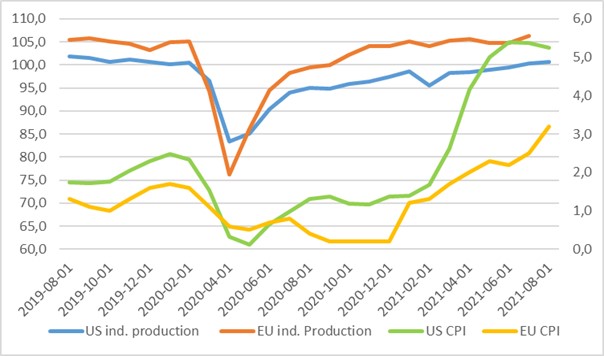
Mainstream economists define inflation as an increase in consumer prices which occurs when the growth of money supply outpaces economic growth.1 In other words, too much money is chasing too few goods. If the recent surge in inflation were driven by a shortage of goods rather than an increase in the money supply, then aggregate output would be shrinking. But this is not the case, because global economic output is projected by the Organisation for Economic Co-operation and Development to grow by 5.7 percent in 2021 after having dropped by 3.4 percent in 2020. This year, the output lost during the pandemic is expected to be recovered in both advanced and emerging economies, including in the US (graph 1). As a matter of fact, inflation was accelerating this year at the same time that industrial production was recovering to prepandemic levels in both the US and the EU (graph 2). The alleged shortage of supply at an aggregate level appears to be a myth.
Graph 1: Real GDP growth

Source: IMF World Economic Outlook.
Graph 2: Inflation and industrial production
Source: FRED and Eurostat.
The invoked shortage of supply is primarily based on anecdotal evidence about unmet demand and rising prices in specific economic sectors, such as semiconductors, cars, furniture, and energy. But those who claim that supply is insufficient do not bother to analyze whether the squeeze of supply chains is due to chronic shortage of production or to excess demand. Moreover, even if supply were short for certain goods due to production lockdowns, changes in consumer schedules, or environmental greening policies, a surge in the aggregate price level would not take place if the money supply and aggregate demand remained broadly unchanged. The squeeze on some individual supply chains would be compensated for by lower demand for other goods and services, and only relative prices would change in the economy.
Let us have a closer look at specific cases of widely perceived supply bottlenecks. The shortage of shipping containers and logistic problems at several ports in the US and Asian countries seems central to many other supply chain bottlenecks. Shipping costs have soared indeed, but shipped volumes have increased as well (graph 3).2 This does not indicate a lack of supply, but rather buoyant demand for international transport. Experts from leading shipping groups report that major US ports, container groups, and logistics companies can barely handle the surge in international trade. This is not surprising given that both US imports and its trade deficit surged by more than 20 percent year on year in the first seven months of 2021, as consumers rushed to spend their stimulus checks. United Nations Conference on Trade and Development experts claim that the global demand for manufactured consumer goods increased throughout the pandemic, boosting the demand for container shipping and raising transportation costs. The surge in global demand has not only rearranged international trade flows to the advantage of China and other Asian economies, but has also pushed international trade volumes to new highs (graph 4).
Graph 3: Global TEU shipping volume and price index

Source: Container Trades Statistics.
Graph 4: Global volume of trade

Source: World Trade Organization.
The shortage of semiconductors, which affects car production, is also blamed on the inability of chip manufacturers to deal with an order backlog swollen by covid-19 and shipping disruptions. But the global semiconductor market expanded by 7 percent in 2020 and is projected to grow by another 20 percent this year (graph 5) and almost double in size by 2028. So, again, the shortage is being caused by a relatively rigid supply which cannot accommodate buoyant demand. The latter has increased not only from the automotive sector, in particular as electric vehicles use more chips, but also from manufacturers of computers and other consumer electronics, the consumption of which has surged during the pandemic.
Graph 5: Global market for semiconductors

Source: Statista 2021.
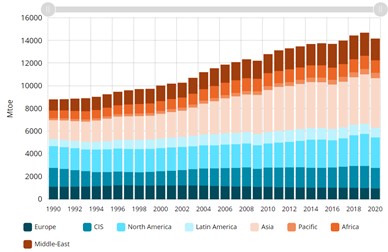
The recent rally in energy prices, with coal and European gas hitting record highs and crude oil pushing above $80 a barrel, is also attributed to a constrained supply and perceived as a threat to the economic recovery. But the global supply has not shrunk; on the contrary, the world production of energy has been on a steady upward trend (graph 6). After growing by about 2.4 percent per year for the past three years, energy production fell by 3.5 percent in 2020 due to the lockdowns, but is expected to rebound by 4.1 percent in 2021.
Graph 6: World energy production
Source: Enerdata.
The global energy supply would have been much higher and better balanced among sources and across regions had it not been for government-mandated green policies and carbon emission targets. In Europe, coal plants have been gradually phased out, as have nuclear power plants in Germany. They have been replaced by wind turbines and other renewable energy sources which underperformed recently due to adverse weather conditions. Together with lower gas deliveries from Russia, this has created a perfect storm in the European energy market. At the same time, China’s strict emissions targets and rising coal prices have also generated a power crunch, disrupting factory activity.
In the same way that green government policies have undermined the production of energy, the lockdowns and stimulus paychecks generously handed out during the pandemic have created an artificial shortage of labor that is likely to exacerbate further inflationary pressures. Due to forced business closures, the US economy lost about 20 million jobs by April of last year. Despite the economic recovery, some 5 million jobs have not yet been filled, as millions of Americans have been paid to stay home or have left the labor force altogether. In Europe, trade unions are already asking for pay increases while surveys show that inflation expectations are rising.
Excessive Demand Stimulus and Money Creation Are the Real Culprit
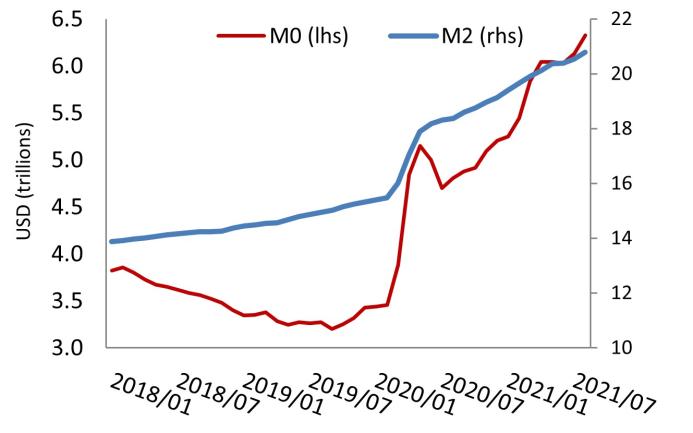
The growth stimuli applied during the pandemic have been truly unprecedented in size and outreach. Massive government support and budget deficits monetized by central banks have been poured over economies weakened by recurrent lockdowns. Despite the loss of jobs and market incomes, US household wealth has increased by a staggering $32 trillion since the beginning of the pandemic, fueling consumer spending and aggregate demand. Together with an increase in the broad money supply by more than a third over the same period (graph 7), this indicates that the inflation is actually driven by too much money rather than too few goods.
Graph 7: Money supply
macovei7.jpg
Source: FRED.
The rapid rise in inflation is also raising inflation expectations.3 Inflation depends not only on the mechanical outcome of changes in the supplies of money and goods, but also on the demand for money. If the public realizes that its cash holdings are being eaten away by significant price increases, it will move away from cash. In this case, inflation would accelerate beyond the pace of money creation, which is obviously the nightmare of all central bankers.
Conclusions
The current surge in inflation is neither due to a shortage of supply nor transitory, as central banks want us to believe. It is primarily due to soaring consumer demand fueled by excessive growth stimuli and monetary creation. Government-imposed lockdowns and clean energy policies constraining output have exacerbated price increases. We are witnessing a consumption boom and persistent distortions in the structure of production, all bearing a striking resemblance to the boom that preceded the Great Recession.
- 1.This definition is disputed by Austrian economists because price inflation lumps together monetary and nonmonetary causal factors, which have different consequences for the structure of production, incomes, and individual wealth. Therefore, Austrian economists define inflation as an increase in the supply of money beyond an increase in specie, i.e., commodity money such as gold or silver.
- 2.According to the Financial Times, it costs more than $20,000 to ship a standard container from China to the East Coast of the US today, up from less than $3,000 two years ago.
- 3.In the US, Consumer Price Index inflation advanced by 5.3 percent in August, housing prices grew by almost 20 percent year on year as of July, and the S&P 500 Index was up by almost 29 percent year on year at the end of September.
Author:
Dr. Mihai Macovei (macmih_mf@yahoo.com) is an associated researcher at the Ludwig von Mises Institute Romania and works for an international organization in Brussels, Belgium.
DC’s extended coronavirus ’emergency’ is about the almighty dollar.
Washington, D.C., Mayor Muriel Bowser extended the city’s state of emergency into 2022 even though there have been fewer than a dozen coronavirus deaths over the past month and local transmission remains at a seven-day average rate of 20 new daily cases per 100,000 people. The vaccination rates in the district are also well above average, with more than 70% of residents either partially or fully vaccinated against COVID-19.
The data are clear: The pandemic is no longer an emergency here. It hasn’t been for quite some time. Indeed, Washington residents are now more likely to die from gunshots than from COVID-19. Yet city officials are dragging this out as long as they can, with prolonged mask mandates and now an extended emergency order that allows Bowser to implement new restrictions whenever she wants.
But here’s the kicker: Bowser’s state of emergency allows the city to continue receiving federal reimbursement funds and additional federal coronavirus relief, according to local news outlet WTOP. None of this has anything to do with health and safety — it’s about power and money.
As long as there is money to rake in, the coronavirus “state of emergency” will never end — city officials have made that clear. They refuse to set specific parameters for lifting restrictions, and now we understand why. The pandemic theater must go on.
Businesses have started refusing to comply. Bowser doesn’t even bother to follow her own mask mandates half the time — why should anyone else? Flu season is approaching, and soon they’ll use that to justify prolonged mask mandates and school closures. The sooner we stop listening, the sooner this will all be over.
Washington Examiner
One Way
One Way
There is only one way of salvation:
by God’s grace alone,
through faith alone,
in Jesus Christ alone,
to the glory of God alone,
as revealed by the supreme
authority of scripture alone.
R.C. Sproul
Global geopolitical regions can be divided into five main areas — North America and the Caribbean, Europe and the Middle East, the Indo-Pacific, South and Central America, and Africa. Nine months into the Biden administration, the new president faces dangers and challenges of his own making in all five.
C.H. Spurgeon
Never Be Thirsty
But whoever drinks of the water that I will give him will never be thirsty forever.John 4:14
The person who believes in Jesus finds enough in his Lord to satisfy him now and to content him forevermore. The believer is not the man whose days are weary for lack of comfort and whose nights are long on account of the absence of heart-cheering thought. The believer finds in faith such a spring of joy, such a fountain of consolation that he is content and happy. Put him in a dungeon, and he will find good company; place him in a barren wilderness, and he will eat the bread of heaven; drive him away from friendship, and he will meet the “friend who sticks closer than a brother.”1 Destroy all his shade, and he will find shadow beneath the Rock of Ages; erode the foundation of his earthly hopes, but his heart will still be fixed, trusting in the Lord.
The heart is as insatiable as the grave until Jesus enters it, and then it becomes a cup full to overflowing. There is such a fullness in Christ that He alone is the believer’s sufficiency. The true saint is so completely satisfied with the provision of Jesus that he no longer thirsts—except perhaps to drink more deeply at the living fountain.
In that sweet manner, believer, you will thirst; it will not be a thirst of pain, but of loving desire; you will find it a sweet thing to be longing for a deeper enjoyment of Jesus’ love. An old saint once declared, “I have been lowering my bucket into the well so often, but now my thirst for Jesus has become so insatiable, that I long to put the well itself to my lips and drink right out of it.”
Is this the feeling of your heart now, believer? Do you feel that all your desires are satisfied in Jesus and that you have no need now except to know more of Him and to have closer fellowship with Him? Then come continually to the fountain, and take the water of life freely. Jesus will never think you take too much but will always welcome you, saying, “Drink; yes, drink abundantly, loved one.”
1) Proverbs 18:24
What The Arizona Audit Really Shows
Critics of the forensic audit of Maricopa County, Arizona—including local election officials and many reporters—who are crowing that the audit confirms that President Joe Biden won the election in Arizona, either don’t understand the purpose of an audit or are trying to deliberately obscure the most worrying findings in the audit.
In fact, by concentrating on only one finding—that the hand recount essentially matched the machine count from last November—they are missing the forest for the trees. That is shown by misleading headlines such as that in The Washington Post: “Ariz. Ballot Report Affirms Biden Win and Lack of Fraud.”
No one doubts that the vote tabulation shows that Biden won the state. The fact, however, that the hand recount essentially matched the machine count from last November comes as no surprise to anyone with experience in election administration.
As a former county election official in two different states, I was involved in multiple recounts. Recounts almost always only show slight differences from the original ballot tabulation. The fact that the hand recount in Maricopa County matched the machine recount simply means that the computer scanners used to scan and tabulate paper ballots were working properly.
However, the key point all of the critics of the audit are missing is that a recount simply recounts the ballots that were cast—a recount does not investigate, examine, or review the legitimacy of those ballots.
A recount does not verify or check whether ballots were cast by registered voters who are actually deceased; who do not actually live where they claim to live; who cast multiple votes because they are registered more than once; or who are not entitled to vote even though they are registered because they are not U.S. citizens or are felons who have not yet had their right to vote restored.
A simple example illustrates this problem. If a homeowners’ association has an election and the new president wins with 51 out of 100 votes, a recount will no doubt confirm that she received 51 votes. But it will not reveal whether 10 of her 51 votes were cast by individuals who falsely claimed to live in the neighborhood when they actually live elsewhere.
Volume III of the Maricopa audit lists some disturbing findings. That includes 23,344 “mail-in ballots voted from a prior address”; 9,041 “more ballots returned by voter than received”; 5,295 “voters that potentially voted in multiple counties”; 2,592 “more duplicates than original ballots”; and 2,382 “in-person voters who had moved out of Maricopa County.”
Numerous other problems are listed, such as voters whose ballots were counted despite the fact that they registered to vote after the state deadline for registration had already passed.
These are serious potential problems that should be investigated by election officials with the involvement of law enforcement. For example, the individual voter files of the 5,295 “voters that potentially voted in multiple counties” should be pulled, and each voter should be investigated to determine if they have multiple registrations and, in fact, illegally cast more than one vote in the 2020 election.
In other words, all of the potential problems that the auditors found ought to be investigated to verify what actually happened in each case with each of these voters. That is the only way to determine whether there were 5,295 double votes cast in the election or whether some or none of these voters were, in fact, double registered. This claim might be found to be valid—on the other hand, an in-depth investigation might find that there is no validity to this claim or any of the other claims.
Contrary to what some seem to believe, the purpose of an audit is not to overturn an election. It is too late to do so. Every state has election laws that provide very short deadlines for a losing candidate to contest the outcome of an election. That deadline has long expired in Arizona and every other state.
Instead, audits are intended to determine whether voting machines worked properly; whether applicable state and federal laws and regulations were followed; whether the voter registration list was accurate and up-to-date and only allowed eligible individuals to vote; and whether all eligible voters were able to vote, that their vote was properly counted, and that their votes were not voided or nullified by fraud, mistakes, or errors.
The results of such an election audit can then be used to correct any compliance issues, to prosecute anyone who engaged in intentional misconduct that violates state or federal election laws, to change election administration procedures that led to errors and mistakes by election officials, and to provide legislators with the information they need to make needed amendments to election laws to make sure any problems that were found do not reoccur in future elections.
What is most disturbing about the reaction to the audit report is that so many seem to think that this is the end of the review process since the hand recount showed that Biden won and, thus, nothing else needs to be done. This attitude is especially disturbing in Maricopa County election officials, who from the very start have done everything they could to obstruct the audit and who are now claiming that since their “canvass” was accurate, they don’t need to do anything else.
That attitude is wrong. The audit seems to have revealed that sloppy, careless, and chaotic procedures were utilized in Maricopa County during the last election. Officials there have a duty to not only investigate all of the potential problems the audit found, such as potential multiple registrations by the same individual, but to correct their procedures and implement better training for their election workers to ensure that such problems, if confirmed, do not happen again.
Arizona law enforcement also has an obligation to investigate. Casting multiple ballots in the same election is a crime, as is registering and voting where you don’t actually reside. Failure of state election and law enforcement officials to fulfill their duties to investigate will reflect poorly on them.
Finally, opposing the conduct of election audits is unwise and unjustified. Audits are a routine occurrence in the business world for good reason. Conducting random or comprehensive audits after an election in every state should also be routine.
Contrary to the bizarre claim of election officials in Harris County, Texas, that audits are “an attack by officials on our communities’ trust in elections,” audits are a way of protecting voters, ensuring the security of the election process, and improving the confidence of the public in the integrity of elections.
From The Daily Signal
The Only Way
Today is Monday, October 4th, 2021, and Jesus Christ is still the only Way to heaven.
 amallory54